
Illuminating the Dark- Central Park Bat Research
White-nose syndrome is a fungal infection caused by Pseudogymnoascus destructans (Pd) that has caused dramatic declines in several species of North American bats, including those residing in Iowa. Once at a site this infection can cause death in 90-100% of the bats overwintering there. This disease was first detected in the United States in 2006 in a cave near Albany, New York and has steadily spread to many parts of the country in the 20 years since. Bats are known as a keystone species, meaning they have a disproportionate impact on their ecosystems and so a dramatic drop in their populations has ripple effects on others. This is why studies understanding local disease impacts are important.
Jones County Conservation has partnered with the Iowa Department of Natural Resources (DNR) since 2022 on conducting guano surveillance at several Central Park bat boxes. Based on the consistent detection of Pd in that guano (bat poop), the Iowa DNR is now working with the Iowa State University Veterinary Diagnostic Laboratory (ISU VDL) to not only test the guano samples but to bring on Master’s student and Monticello-native Faith Hansen to study the bats living at Central Park. This new project will involve monitoring individual bats over the next two years to understand how their disease status might be affecting their activity patterns and reproductive success.
In order to do the study, a team was put together to capture and test the bats this spring, after they emerged from hibernation but before pupping season. This team included Faith, Jones County Conservation staff, Iowa DNR state wildlife veterinarian Dr. Rachel Ruden, and Central College professor and bat biologist Dr. Russell Benedict. In May, over 100 little brown bats (Myotis lucifugus) were safely captured as they left the bat boxes using a harp trap, and then processed as follows. Bats were evaluated using a blacklight to look for fungal presence and scarring, then swabbed to screen for the fungal pathogen, and finally PIT tagged (Passive Integrated Transponders, similar to a microchip) for permanent identification and to track the bats’ movement over time. The team also collected some basic health or biological information such as: species, sex, weight, forearm length, and pregnancy status when possible. The swabs will be taken to the ISU VDL and tested for fungal presence to determine each individual bat’s exposure status. Meanwhile, devices set up at two of the bat boxes will record activity patterns as tagged bats go on foraging bouts each night. All of this data will then be compiled to look at potential disease impacts and contribute to the larger body of science around white-nose syndrome!
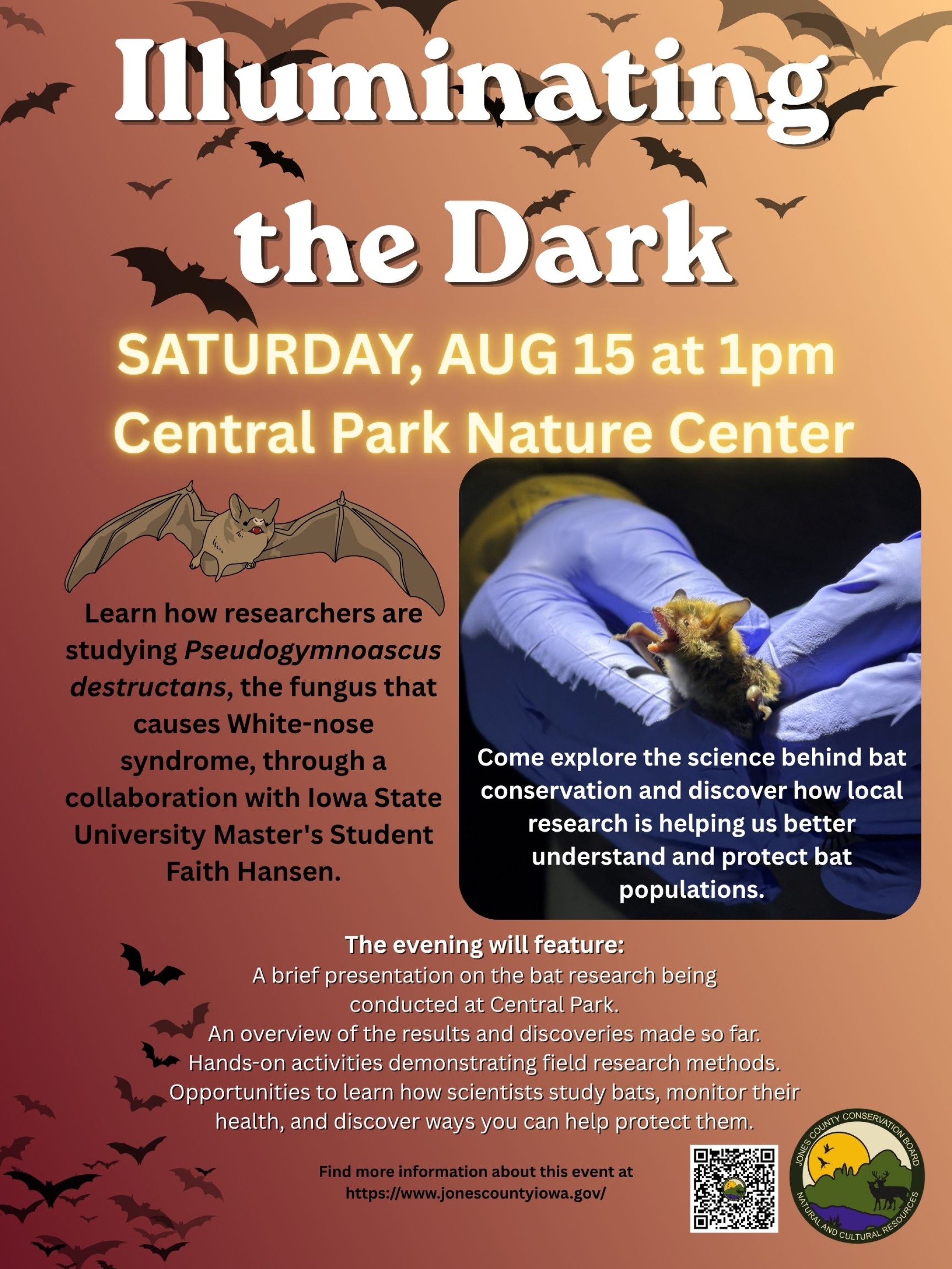
The Central Park Nature Center will be having a program August 15th, 2026 at 1 pm that will allow everyone to come and learn about this project in a fun and interactive environment with Faith Hansen. The program will include a short presentation on the project then mock activities of the processing that occurs on site during the capture nights! This is an event for all ages; we hope to see you there! Keep up to date on Jones County events at www.jonescountyiowa.gov/conservation/
To listen to Faith speak about her project visit KDTH and listen to the June 26th edition of The Outdoor Journal podcast . https://www.radiodubuque.com/outdoorjournal/